Price:
Duct air heaters are designed for heating or preheating clean air in mechanical ventilation systems. They are installed directly in supply air ducts and can be used in simple systems with an inline duct fan, with heat recovery units, air handling units (AHUs), and other air supply and air treatment systems.
This category includes two main types of duct air heaters:
In EHC electric models, the air is heated by electric heating elements. Models are available in different duct diameters, heating capacities, supply voltages, number of phases, temperature ranges and control configurations – from basic versions without integrated electronic control to models with temperature control, 0–10 VDC control, airflow and pressure monitoring, and other automation functions.
In HDW water duct heaters, the air is heated by heat transferred from hot water through a heat exchanger. They are designed for systems where a suitable hot water source is available and its heat is to be used for heating the ventilation supply air.
EHC electric duct heaters are used when the supply air in a ventilation system needs to be heated to the required final supply air temperature.
In a simple mechanical air supply system, an inline duct fan supplies outdoor air, while an electric heater installed in the duct raises its temperature to the required level. Therefore, a duct heater can also be used in a system without a heat recovery unit.
In a system with a heat recovery unit, the electric heater can be installed downstream of the heat recovery unit and used as an additional supply air heater. For example, if the supply air temperature after heat recovery is +15 °C and +22 °C is required, the duct heater additionally heats the air to the set temperature.
Electric air heaters can also be used with air handling units (AHUs) and other air supply or air treatment equipment when the supply air temperature needs to be increased further.
The standard temperature setting range for EHC heaters is 0...+30 °C. Other temperature ranges are available on request.
EHC electric duct preheaters are designed to preheat cold air to a specified intermediate temperature. The air can then be additionally heated, pass through heat recovery, or undergo further treatment in the ventilation system.
Preheaters are not intended exclusively for systems with heat recovery units. They can be used in simple air supply systems with an inline duct fan, upstream of heat recovery units, air handling units (AHUs), and other air treatment equipment.
In a system with a heat recovery unit, an electric preheater can be installed in the outdoor air duct upstream of the heat recovery unit. It heats cold outdoor air to the temperature required for operation of the specific ventilation unit and can be used to protect the heat exchanger against freezing.
For example, if the outdoor air temperature is -20 °C and the next system component requires air no colder than -5 °C, the preheater can raise the air temperature from -20 °C to -5 °C.
The standard temperature setting ranges for EHC preheaters are -10...+20 °C and -30...0 °C. Other temperature ranges are available on request.
EHC preheaters are additionally thermally insulated because they are designed to operate with low-temperature air.
HDW water duct heaters are designed to heat supply air in mechanical ventilation systems using hot water as the heat transfer medium.
Hot water circulates through the HDW heat exchanger, while the air passing through the heater absorbs the heat transferred by the heat exchanger. Therefore, an HDW heater requires a suitable hot water source and water circuit.
HDW heaters can be used in simple mechanical air supply systems with an inline duct fan, systems with heat recovery units, air handling units (AHUs), and other air supply and air treatment systems.
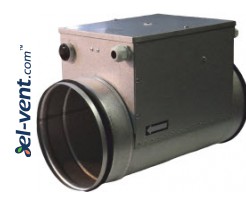
EHC – electric duct heaters and preheaters where electricity is used for heating.
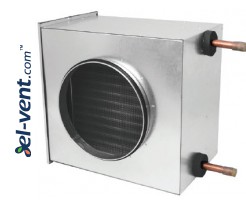
HDW – water duct heaters where heat is supplied by a hot water system.
When selecting an EHC, it is important to consider heating capacity, power supply and control. When selecting an HDW, the water temperatures, water flow rate and heat exchanger capacity must be considered.
Continue reading at the bottom of the page.
EHC electric duct heaters and preheaters are available either without integrated electronic control or with integrated control automation. The appropriate version is selected according to what will control the heating, how the temperature will be set, and which additional monitoring and control functions are required.
Basic EHC models do not have an integrated electronic temperature and power controller, therefore their operation must be controlled by an external automation system.
This may be a heat recovery unit or air handling unit controller, a separate electric heater controller, a building management system, or another suitable external control system.
This version is suitable when all functions required to control the heater are already provided by the overall ventilation system automation.
EHC../CE models have integrated electronic power control operated by an external 0–10 VDC signal.
The external controller calculates the required heating output and sends the corresponding 0–10 VDC control signal to the EHC. This allows the heating output to be regulated according to the requirements of the ventilation system.
The CE version is suitable for systems where the heater is controlled by a heat recovery unit, air handling unit, programmable controller, or other automation system with a suitable 0–10 VDC control output.
EHC../SE models have an integrated electronic controller, while the required temperature is set using an external temperature setting device.
A duct temperature sensor installed in the airflow downstream of the heater or preheater is used for temperature control.
The SE version is suitable when autonomous temperature control is required, but it is more convenient to set the temperature at a location accessible to the user or system operator rather than directly on the EHC installed in the duct.
EHC../SI models have an integrated electronic controller, and the required temperature is set directly on the EHC.
A duct temperature sensor installed in the airflow downstream of the heater or preheater is used for temperature control.
The SI version is suitable for autonomous ventilation systems where a separate external temperature setting device is not required.
An electric duct heater or preheater must operate only when sufficient airflow is present. The airflow removes the heat generated by the heating elements; therefore, insufficient or interrupted airflow may cause the heater to overheat.
EHC units can be equipped with integrated airflow and pressure monitoring functions.
The F function monitors airflow in the duct. It detects whether air is flowing through the EHC and prevents heater operation when there is no airflow.
The SR function is designed to monitor pressure in the duct.
Available pressure monitoring ranges:
The FC configuration incorporates airflow and pressure monitoring.
It monitors the air movement required for safe heater operation and prevents operation when no airflow is present.
FC can be combined with different EHC control options, including, for example, EHC../CE/FC, EHC../SE/FC and EHC../SI/FC configurations.
EHC../MB models feature an RS-485 MODBUS interface for integrating the heater or preheater into a Building Management System (BMS) or another MODBUS-compatible automation system.
This version is intended for buildings where ventilation and heating equipment is centrally controlled and the EHC must operate as part of the overall building automation system.
RS-485 MODBUS can be combined with other EHC control and monitoring functions.
The configuration of three-phase EHC units depends on the selected control version.
In three-phase EHC heaters and preheaters without integrated control automation, a contactor is not included as standard.
For example, EHC200/6.0/3 is a three-phase EHC without integrated control automation, therefore a contactor is not included in its standard configuration.
From 2026-09-01, a contactor is included as standard in three-phase EHC models equipped with integrated control automation.
For example, EHC200/6.0/3/SI/FC/K features integrated SI control, airflow and pressure monitoring, and a contactor.
EHC round electric duct heaters and preheaters are designed for direct installation in circular duct systems.
The casings are manufactured from Aluzinc-coated sheet metal, while stainless-steel tubes are used in the heating elements. Sealing gaskets are provided at the duct connections to ensure a tight connection to the ventilation duct system.
Preheaters are additionally thermally insulated.
Main standard EHC technical characteristics:
Other capacities and temperature setting ranges are available according to specific project requirements.
EHC electric duct heaters and preheaters use two overheating protection thermostats.
Models with a diameter below 250 mm use a 60 °C automatic-reset thermostat.
Models with a diameter of 250 mm and larger use a 70 °C automatic-reset thermostat.
In addition, a 100 °C manual-reset safety thermostat switches off the heating in the event of overheating. The manual reset button is located on the EHC casing.
In single-phase models, the thermostats are connected in series with the heating element, therefore an additional external relay is not required for this overheating protection function.
For two-phase and three-phase models, a relay or contactor is required for the overheating protection function, except for models where the corresponding device is already installed inside the EHC.
The capacity of an electric duct heater or preheater cannot be selected solely according to the duct diameter.
The required heating capacity primarily depends on:
The greater the airflow through the heater and the greater the required temperature increase, the higher the required heating capacity.
Therefore, two EHC units with the same duct diameter may have completely different heating capacities. The duct diameter defines the connection size but does not by itself determine the required heating capacity.
When selecting an EHC, the design or actual ventilation system airflow and the air temperatures before and after the heater must be known.
EHC PTC models use PTC heating elements with self-regulating properties.
Advantages of the PTC design include compact heater dimensions, low pressure drop and the operating principle of self-regulating PTC heating elements.
EHC PTC units can be used both as heaters and preheaters and can be equipped with integrated electronic control as well as airflow and pressure monitoring functions.
The EHC PTC range includes:
EHC TR units are compact, short-casing electric duct heaters and preheaters designed for systems where there is insufficient duct space to install a standard EHC.
The TR version performs the same basic air heating or preheating functions, but its compact construction makes installation easier where space is limited.
The EHC TR range includes:
EHC TR units can also be equipped with different integrated control and airflow/pressure monitoring options.
An electric duct heater or preheater is part of the complete ventilation system; therefore, its safe and efficient operation depends on the correct selection of airflow, fan, duct system, electrical power supply and control automation.
The minimum air velocity through an EHC must be at least 1.5 m/s.
Heating capacity must be selected according to the actual ventilation system airflow and required temperature rise, not solely according to duct diameter.
Electrical connection, protection and control arrangements must correspond to the capacity, number of phases and configuration of the specific EHC model.
If an EHC is used as a preheater upstream of another ventilation system component, the set air temperature must comply with the operating requirements of that component and the complete system.
With the correct selection of application, capacity, temperature range and control method, EHC units can be used both in simple mechanical air supply systems with an inline duct fan and in complex automated ventilation systems with heat recovery units, air handling units and centralised building automation.
HDW water duct heaters are designed for heating supply air in mechanical ventilation systems using hot water as the heat transfer medium.
Unlike EHC electric duct heaters, HDW units do not generate heat using electric heating elements. Hot water circulates through the heater's heat exchanger, while the air passing through it absorbs the transferred heat. Therefore, an external hot water source and a properly designed water circuit are required.
HDW heaters can be used in simple mechanical air supply systems with an inline duct fan, systems with heat recovery units, air handling units (AHUs), and other air supply and air treatment systems.
Hot water for the HDW heater can be supplied by a building's central or local heating system, boiler, heat pump, or another heat source capable of providing the required heat-transfer-medium parameters.
HDW heaters are designed for direct installation in circular duct ventilation systems.
The heater casing is manufactured from galvanised steel. The heat exchanger tubes and water connections are made of copper, while aluminium fins are used to increase the heat transfer surface.
This heat exchanger construction transfers heat from the hot water to the air passing through the heater: water circulates through the copper tubes, heat is transferred to the aluminium fins, and the airflow passing across them is heated.
Rubber sealing gaskets are used at the duct connections to ensure a tight connection between the heater and duct system.
The HDW construction also provides access to the heat exchanger for periodic maintenance and cleaning.
HDW water duct heaters are available for the following circular duct diameters:
Maximum heat transfer medium operating temperature – 100 °C.
Maximum operating pressure – 1.0 MPa (10 bar).
Main construction materials:
HDW heaters are not limited to one specific type of ventilation unit. They can be used in various mechanical ventilation systems provided that the required airflow and hot water supply parameters are ensured.
In a simple air supply system, an inline duct fan can move air through the HDW heater, which raises the supply air temperature to the level required by the system.
In a system with a heat recovery unit, an HDW can be used as an additional supply air heater when the air temperature after heat recovery needs to be increased further.
HDW heaters can also be used with air handling units (AHUs) and other air treatment equipment.
An HDW cannot be correctly selected solely according to the duct diameter.
When selecting an HDW, the following parameters must be considered:
The greater the airflow through the heater and the greater the required air temperature increase, the greater the amount of heat required.
Unlike an electric EHC, where nominal electric heating capacity is a characteristic of the specific model, the heat output transferred by an HDW also depends on the actual operating parameters of the water circuit.
The same HDW heater can provide different heating outputs depending on the supply and return water temperatures, water flow rate and airflow.
Therefore, an HDW must be selected according to the design operating parameters of the specific ventilation and heating system.
The heating output of an HDW is controlled by regulating the amount of heat transferred through the heat exchanger. In a water-based system, this is related to controlling the heat transfer medium flow and temperature.
Depending on the specific ventilation and heating system, the HDW can be controlled by external automation which, according to temperature sensor signals and the required supply air temperature, controls the water circuit equipment.
Therefore, the HDW control solution must be selected together with the specific system's water circuit, fan or air handling unit, and automation system.
EHC and HDW perform the same basic function – transferring heat to air flowing through a duct – but use different heat sources.
EHC generates heat using electric heating elements. Depending on the model, an EHC can feature integrated electronic control, temperature regulation, 0–10 VDC control, airflow and pressure monitoring, an RS-485 MODBUS interface and other functions. EHC units can also be used as cold-air preheaters.
HDW receives heat from hot water circulating through its heat exchanger and therefore requires an external heat source and water circuit.
EHC is a suitable choice when electricity is intended to be used for air heating or preheating, when no suitable hot water source is available, or when specific integrated EHC control functions are required.
HDW is a suitable choice when a suitable hot water source is available and its heat is to be used for heating ventilation air.
The final choice between EHC and HDW should take into account ventilation airflow, required heating capacity, available energy sources, available electrical power, water system parameters, control solution and the operating conditions of the specific installation.