Catalog
Price:



Access panels, access doors and inspection hatches provide convenient access to building services concealed behind walls, ceilings and inside ventilation ducts. At el-vent.com, you can find plastic, metal and stainless steel access panels, plasterboard access doors for filling and painting, concealed magnetic tile access panels, fire-rated access hatches, chimney inspection doors and duct cleaning access panels. Choose from different sizes, materials, opening mechanisms and specialised solutions for residential, commercial and industrial buildings. When selecting a product, consider the installation location, wall or ceiling finish, required access opening and technical specifications.
We deliver worldwide.
Continue reading at the bottom of this page.
Access panels are removable or hinged components installed in walls, partitions or ceilings to provide access to concealed building services. Access doors and inspection hatches serve a similar purpose, but their construction may also be designed for specialised technical applications, such as ventilation ducts, fire-rated partitions or large maintenance openings.
Access panels are used to reach water supply and heating pipes, water meters, manifolds, electrical connections, ventilation equipment, control dampers, fire dampers and other technical installations. A properly designed access opening allows inspection, adjustment, cleaning and repair without damaging or dismantling the surrounding wall or ceiling finish.
The el-vent.com catalogue groups access panels and inspection hatches according to their construction, materials and intended applications. Available solutions include plastic, metal and stainless steel access doors, plasterboard and tile access panels, fire-rated access hatches, chimney inspection doors and ventilation duct cleaning panels.
Plastic access panels are designed to provide access to building services behind walls and ceilings. The catalogue includes ABS plastic products that do not rust, are easy to maintain and can be used in various indoor environments, including humid rooms where permitted by the manufacturer's instructions.
These access doors are commonly installed in bathrooms, toilets, kitchens, utility rooms and service recesses. They provide access to water meters, shut-off valves, plumbing connections and electrical installations.
The plastic access panel range includes different colours and dimensions. When choosing a panel, consider the opening size, door opening direction and whether the panel needs to be fully removable.
Metal access panels are selected when a more robust construction, larger maintenance opening or special locking mechanism is required. The catalogue includes steel, galvanised steel and stainless steel access doors.
Depending on their design, metal access panels may have push-to-open spring latches, square-key locks or other mechanical closure systems. Lockable access doors are especially useful in service rooms and locations where unauthorised or accidental opening should be prevented.
Stainless steel access panels are suitable where corrosion resistance, surface durability or a particular architectural appearance is important. However, the suitability of stainless steel for an aggressive environment depends on its specific grade and operating conditions.
This category also includes large access panels for larger maintenance openings. Such products are useful for servicing heat recovery units, pipework assemblies and technical equipment where a small inspection opening would not provide sufficient access.
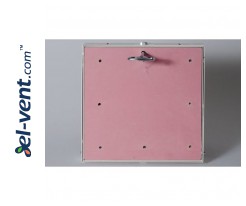
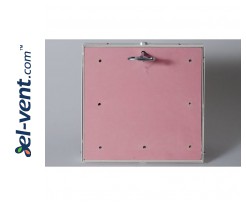
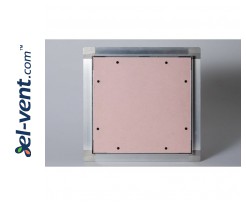
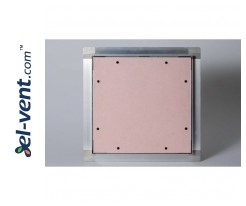
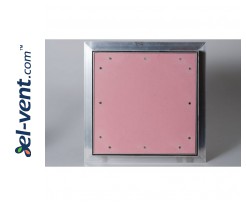
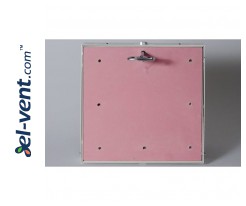
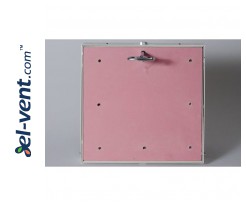
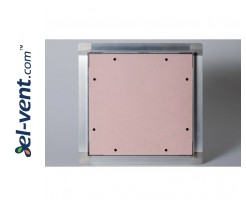
Plasterboard access panels, also known as drywall access doors or plaster-in access panels, are designed for installation in plasterboard walls, partitions and suspended ceilings.
Depending on the model, they may have an aluminium frame with a plasterboard infill or a plastic frame specially designed for finishing. Many of these products can be filled and painted, allowing the visible surface to blend into the surrounding wall or ceiling.
These concealed access panels are particularly useful in modern interiors where a continuous, unobtrusive wall or ceiling finish is desired.
The catalogue contains versions for 12.5 mm and 25 mm plasterboard constructions, as well as large and custom-size access openings. Before selecting a model, verify the board thickness, permitted mounting position, maximum dimensions and door opening direction.
For ceiling-mounted access hatches, secure door retention and protection against accidental falling are especially important.
Tile access panels are used in ceramic-tiled walls where access to concealed services must be preserved. They are a practical solution for bathrooms, toilets and other tiled rooms.
The catalogue includes magnetic access panels, concealed tile inspection hatches, stainless steel tile frames and access doors whose panels can be finished with ceramic tiles.
In magnetic systems, the tile is attached to a purpose-made cover or metal plate held in place by magnets. Other designs may use mechanical latches and hinged doors.
To achieve the most discreet installation, position the access hatch in line with the existing tile layout and grout joints. Before selecting a product, check the tile dimensions, thickness, weight, adhesive layer and available door clearance.
Not every plasterboard access panel is suitable for tiling, so it is essential to select a model expressly designed for ceramic tile finishes.
Fire-rated access panels and fire-resistant inspection hatches provide maintenance access through walls, service shafts, partitions and ceilings that are subject to fire-resistance requirements.
Unlike standard access doors, these products use specialised constructions, fire-resistant infills, sealing components and tested installation methods. Depending on the model, they may have aluminium or steel frames, fire-resistant boards and intumescent seals.
The el-vent.com fire-rated access panel range includes different fire-resistance ratings for suspended ceilings, plasterboard partitions, shaft walls and lining walls.
In fire-resistance classifications, E indicates integrity and I indicates thermal insulation. The number specifies the period in minutes for which the tested construction satisfies the relevant criteria under the applicable classification.
For example, EI30 indicates 30 minutes, EI60 indicates 60 minutes, EI90 indicates 90 minutes and EI120 indicates 120 minutes. Other ratings and construction types may also be available in the catalogue.
Fire-rated access panels must not be selected solely by their EI rating. The wall or ceiling construction, thickness, permissible opening dimensions, installation orientation, direction of fire exposure and classification documents must all be considered.
A higher declared EI rating does not automatically mean that an access panel may be installed in any construction with a lower fire-resistance requirement. Suitability must be supported by the manufacturer's documentation.
Chimney access doors provide openings for inspecting, cleaning and maintaining chimney flues. Their construction must be suitable for the operating conditions of the particular chimney system.
The catalogue includes insulated stainless steel chimney inspection doors intended to provide access to the inside of the flue. Different dimensions are available for specific installation requirements.
Chimney inspection doors should not be considered interchangeable with ordinary wall access panels. They must be selected in accordance with the chimney system manufacturer's requirements, installation location and operating conditions.
A universal magnet set is designed for making removable access covers in custom sizes or shapes. Magnetic fixing allows a removable inspection cover to be installed where standard access panels do not match the opening dimensions or the required finish.
Such solutions may be used in walls finished with plasterboard or ceramic tiles, provided that the cover is securely supported and fitted.
When selecting a magnetic fixing system, consider the weight of the cover, the material and the holding force of the magnets. Heavier covers may require several fixing sets.
Duct access doors and duct cleaning access panels are maintenance covers installed in ventilation ductwork. They allow the inside of a duct to be inspected without dismantling the system.
They are used for ventilation duct inspection, cleaning and maintenance. Regular access makes it possible to detect accumulated dirt, check duct connections and perform necessary servicing.
The catalogue includes galvanised steel access panels for round ventilation ducts. Depending on the construction, a sealing gasket helps reduce air leakage through the closed inspection opening.
When choosing a duct access panel, consider the duct diameter, required access opening, installation location and the sealing characteristics of the specific product.
Access panel accessories are components used to open, lock, secure or maintain access doors and their fixing mechanisms.
The catalogue includes square keys for access door locks, suction holders for removing magnetic tile covers and spring-loaded latches.
Before selecting an accessory, verify compatibility with the particular access door model. Keys and latches serving similar purposes are not necessarily interchangeable between manufacturers or product ranges.
The correct access panel depends not only on the opening dimensions but also on the surrounding structure, finish and maintenance requirements.
The nominal size of an access panel does not necessarily equal its outer frame dimensions or the clear access opening. Always consult the manufacturer's dimensional drawing and installation requirements before ordering.
If a filter, damper, measuring instrument or other component must pass through the opening, verify the actual clear width and height.
Access panels may open by push release, spring-loaded latches, magnets or a dedicated key. Choose the mechanism according to how frequently the opening will be used, any access-control requirements and the available clearance.
Push-to-open mechanisms are convenient for frequently accessed openings. Magnetic covers provide a discreet finish, while lockable access doors are useful when access must be restricted.
ABS plastic does not rust and is suitable for many ordinary indoor environments. Painted or galvanised steel access doors provide a robust construction, while stainless steel is selected where greater corrosion resistance is required.
The material name alone does not demonstrate suitability for highly aggressive environments. The specific material grade, surface treatment and manufacturer's stated operating conditions must be considered.
Some access panels feature sealing gaskets, additional acoustic insulation or a certified fire-resistant construction. These characteristics are not universal.
If a project specifies air leakage, smoke leakage, acoustic performance or fire-resistance requirements, refer to the test reports and classification documents for the exact model.
Both provide access to concealed building services. The term access panel or access door usually refers to a removable or hinged element in a wall or ceiling. Inspection hatch can also describe a specialised maintenance opening in a duct or another technical structure.
If the panel remains visible, plastic or suitably graded stainless steel products may be considered. For tiled walls where a concealed opening is preferred, a magnetic or mechanically operated tile access panel is often a practical choice.
Yes, provided that the specific model is approved for ceiling mounting in the manufacturer's installation instructions. Ceiling access hatches require secure fixing and safe door retention.
Plaster-in access panels are designed to receive finishing materials, most commonly in plasterboard walls and ceilings. After filling and painting, the door surface visually blends into the surrounding wall or ceiling.
Only when the selected product is specifically approved for tiling. Check the weight of the tiles and adhesive, panel size, opening direction and any additional fixing requirements specified by the manufacturer.
Choose a purpose-designed magnetic or mechanically operated tile access hatch and align it with the tile joints. Matching the cover dimensions and surrounding finish makes the maintenance opening less noticeable.
The holding capacity depends on the weight of the cover, the strength of the magnets and the fixing arrangement. Compare the actual weight of the tile and cover with the manufacturer's permitted load before installation.
Plastic panels are often selected for ordinary small maintenance openings. Metal access panels are useful when greater structural rigidity, larger dimensions or a lockable mechanism is required. The correct choice depends on the application.
Yes, when the stainless steel grade is suitable for the environment. Corrosion resistance depends on the material composition, surface treatment and exposure conditions.
EI60 means that the tested construction satisfies the integrity E and insulation I criteria for 60 minutes under its applicable test and classification. The rating applies only within the installation conditions defined in the product documentation.
No. Suitability depends on the type and thickness of the wall or ceiling, installation method, permissible dimensions and fire-resistance classification documents.
Yes. The catalogue contains large access panels and certain custom-manufactured solutions. Available sizes depend on the particular product range, installation location and structural limitations.
Duct access doors provide access to the inside of ventilation ductwork, allowing inspection, cleaning and maintenance without dismantling the duct system.
Not unless it has been specifically designed and approved for that application. Chimneys require suitable inspection doors compatible with the chimney construction and its operating conditions.
No. Airtightness, acoustic insulation and fire resistance are separate performance characteristics that require documentation for the specific product. They cannot be assumed for all access panels.
Yes. el-vent.com delivers products worldwide. Shipping costs, delivery times and conditions depend on the destination country, product dimensions, weight and order configuration.
el-vent.com supplies access panels, inspection hatches and accessories for building services in residential, commercial and industrial properties. The range covers standard maintenance openings as well as specialised solutions for plasterboard, ceramic tiles, fire-rated constructions, chimneys and ventilation ducts.
We deliver throughout Lithuania and worldwide. For large, custom-size or specialist access panels, technical specifications and delivery arrangements should be confirmed before ordering.